.png)
Key Takeaways
As a business owner, there’s a strong chance that you’ve heard of a merchant cash advance (MCA), and it’s no wonder. MCAs are pitched constantly through ads, cold calls, and even by other business owners in your network.
On paper, an MCA looks great. When cash is tight and speed matters, a same-day "yes" is hard to pass up. Behind that fast approval, however, hide high costs, unclear terms, and a lasting impact on your ability to qualify for SBA financing. Understanding what an MCA is, the terms that come with it, and the alternatives available is the best way to steer clear of one altogether.
What is a merchant cash advance, and why is it so dangerous?
An MCA is a form of credit where you sell a slice of your future sales for cash today. The application is fast, there's no collateral required, and the reviews (often inflated) make it sound like a small business owner's best option. Approval can happen in a day or two, and the cash lands fast enough to keep your business humming along.
But peel back the friendly branding, and you'll find repayment terms, factor rates, and pressure tactics that set you up to fail. Each of these factors deserves a closer look.
Repayment is based on a percentage of sales or a fixed withdrawal
Instead of monthly loan payments, the MCA is repaid with a percentage of your business’s daily sales, called the “holdback rate,” which falls between 5% and 20%. Alternatively, the MCA may require a fixed daily or weekly withdrawal from your business bank account based on monthly revenue estimates.
Both scenarios can hurt your cash flow, especially if sales dip unexpectedly or you have an unexpected expense. If cash flow gets tight, it can lead to “stacking,” or taking out another MCA loan to pay for the first and another to pay for the second, and so on.
Factor rates are much higher than interest rates
An MCA charges a factor rate instead of an interest rate, and that's where the real cost hides. Factor rates for MCA loans are typically between 1.1 and 1.5.
When you do the math against the daily payment and repayment period, and the APR equivalent tells a much less flattering story:
MCA amount: $30,000
Factor rate: 1.3
Total repayment amount: $39,000
Holdback rate: 10% of daily sales
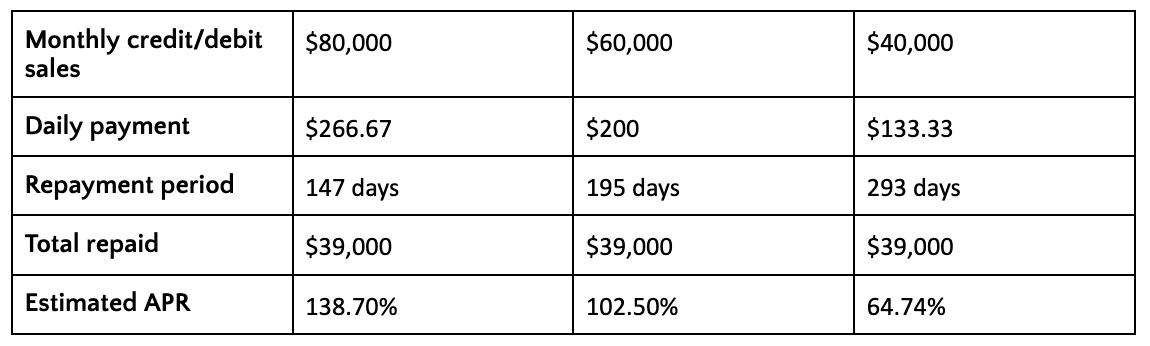
Because the fees and factor rate are calculated upfront, paying the MCA off early won't save you a dime. Contrast this with a conventional loan where you’ll only pay the interest until the loan is paid off, and you can see how MCAs put you at an even deeper disadvantage.
Pressure to move fast means you may not understand the terms
MCA applications come with pressure to sign fast, often with no real time to read the fine print. Withdrawal schedules may not line up with how cash moves through your business, and there are often legal terms attached that put a lien on your business, giving the MCA lender the right to your business assets if you fall behind on payments.
How an MCA can disqualify you from SBA financing
The costs of an MCA don't stop once you've made your final payment. If you ever plan to pursue SBA financing, that decision can follow you long after the advance is paid off. Current SBA guidelines also don’t allow MCA debt to be refinanced into an SBA loan. This is for a few reasons:
- MCAs can negatively impact your debt service coverage ratio (DSCR), the number lenders use to check whether your business brings in enough income to comfortably cover its debt payments. A lower DSCR makes it harder to qualify for an SBA loan down the road.
- The MCA’s repayment structure can raise questions about cash flow and repayment ability.
- An active MCA can signal poor planning since the funds were needed quickly.
If you’ve had an MCA in the past, it doesn’t disqualify you from SBA financing, but lenders may still see it as a red flag for how your business handles money and will need to make sure that MCA lending wasn’t a habit.
Our advice: Proceed with extreme caution
Even if your business needs cash fast, an MCA is rarely the right move. It only makes sense if you're facing a short-term need with a clear, realistic plan to pay it back quickly. If you think you fall into this needle-in-a-haystack scenario, we recommend that you meet with your accountant or financial advisor before moving forward.
When you need money quickly, there are other options. After you’ve talked with your accountant about your financial situation, your next stop should be a lender who can look at the full picture of your business and recommend alternatives. Luckily, there are plenty of financing options, such as SBA loans offered through RBAC, that don't work against you like an MCA does.
Don’t let an MCA throw your business off course
MCAs are a tool that should be considered with extreme caution, and only in rare circumstances. They’re rarely a good fit and never a long-term strategy. More often than not, business owners get themselves stuck in a borrowing cycle that drains their profit.
If you’re thinking about an MCA, we encourage you to talk to a financial professional first. At RBAC, we’re happy to walk you through the best financing options for your business. Our goal is to get you into a loan that strengthens your financial future. Give us a call when you're ready to talk it through.